Plant Business
Project Overview
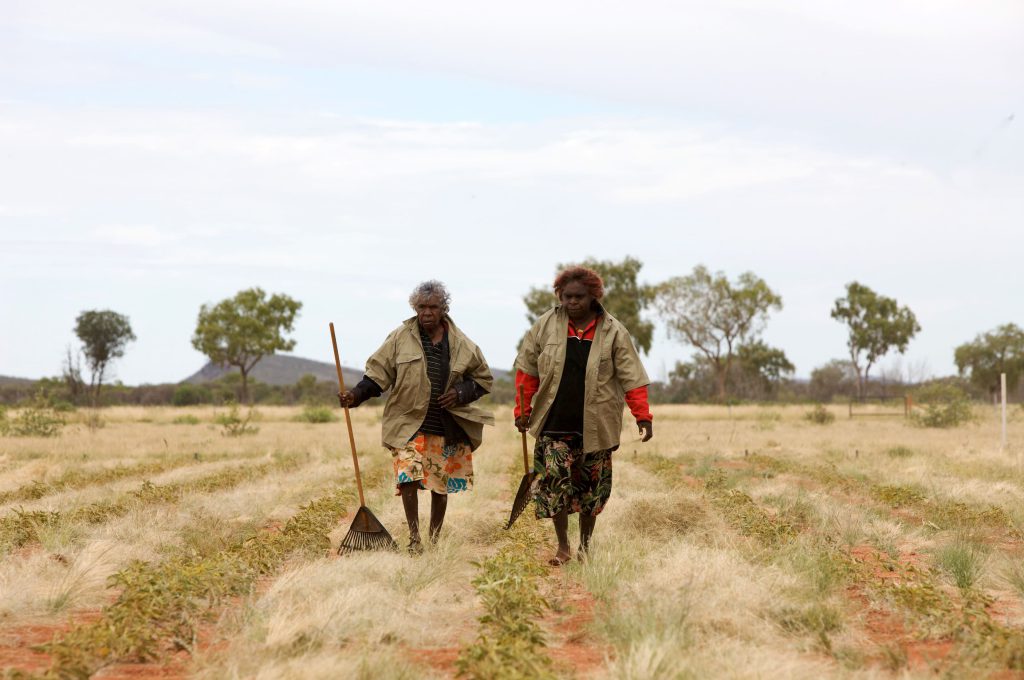
The Plant Business project concluded in June 2017. The project developed the horticultural, fruit quality and genetic understanding of Bush Tomato and worked with Aboriginal and Torres Strait Islander people on plant improvement with a view to using plant varieties developed from defined geographic locations. The project developed a model for improving native plant varieties to make horticultural production of bush foods more efficient and profitable. The focus was on sustained growth of value with the Bush Tomato trade as a case study, to increase business opportunities for remote Aboriginal and Torres Strait Islander people.
The project also explored ways that laws and institutions can help Aboriginal and Torres Strait Islander people to achieve different needs and aspirations associated with their Traditional Knowledge and to secure greater returns for the genetic resources that are used commercially. Strategies that were explored included conventional legal approaches, international protocol compliance, trademarks, certification and Knowledge Trusts, as well as Fairtrade, geographical indicator schemes and other ethical marketing avenues. This delivered tools to help maximise benefit sharing for Aboriginal and Torres Strait Islander people from the utilisation of cultural heritage.
Impact from this research were:
- A model that can be used for the development of other plant-based economies
- Models for safeguarding commonly-held cultural heritage to ensure return of benefits from utilisation of Traditional Knowledge is maximised
- New plantings of high yielding and quality Bush Tomatoes
- New plantings in the future of up to 20 ha of high yielding and quality Bush Tomatoes
- New jobs for Aboriginal and Torres Strait Islander people
- Returns from licences to use protected plant varieties.
Outputs from this research included:
- Genetic collection of Bush Tomato selections established as intellectual property (IP) in trust for Aboriginal owners
- New horticulturally suitable plant varieties that are more likely to be economically profitable under cropping
- Protection of plant varieties leading to licences for their usage
- Alternative strategies for safeguarding the utilisation of cultural heritage
- Training material to support the establishment of small businesses
- Postgraduate student completion: PhD graduate received the University Chancellor’s medal for doctoral research
- Aboriginal researchers trained to continue to develop plant varieties for commercial benefit.
Research results from this project were disseminated widely, with the project publishing 5 journal papers, presenting at 13 conferences and creating 30 other end-user publications.
For more information about this research, please contact Dr Slade Lee: slade.lee@internode.on.net.
Project Outputs
Journal papers
- Lee LS and Courtenay K. 2016. Enrichment plantings as a means of enhanced bush food and bush medicine plant production in remote arid regions – a review and status report. Learning Communities: International Journal of Learning in Social Contexts. 19, Special issue: Synthesis & Integration writing from the Cooperative Research Centre for Remote Economic Participation. pp. 64-75. doi.
- Lingard K. 2015. The potential of current legal structures to support Aboriginal and Torres Strait Islander interests in the Australian bush food industry. International Journal of Sustainable Development & World Ecology. 23(2), pp. 174-185. doi.
- Lingard K. 2015. Legal support for the interests of Aboriginal and Torres Strait Islander peoples in the commercial development of new native plant varieties: Current status and future options. Australian Intellectual Property Journal. 39, pp. 39-57.
- Lee LS. 2015. Safeguarding indigenous cultural heritage during commercialisation of native plants. Acta Horticulture. 1102. doi.
- Lee LS. 2012. Horticultural development of bush food plants and rights of Indigenous people as traditional custodians – the Australian Bush Tomato (Solanum centrale) example: a review. The Rangeland Journal. 34, 4. pp. 359-73. doi.
Conference presentations
- Lee LS. 2015. When River People culture meets commercialisation. AALC Triennial Conference. 18-21 October. Brisbane.
- Lingard K. 2015. Aboriginal and Torres Strait Islander interests in bush food development. 2nd UNE Seeds Colloquium: Cultural Stewardship Risk in Conservation Seed Banks. School of Law, University of New England, Armidale.
- Lee LS. 2015. How commercialisation of Bush Foods invokes Traditional Knowledge considerations. 2nd UNE Seeds Colloquium: Cultural Stewardship Risk in Conservation Seed Banks. 29-30 September. School of Law, University of New England, Armidale.
- Lingard K. 2014. Can cultural interests travel with native seeds accessed from Australian biobanks? UNE Colloquium on Seed Banks and Cultural Interests in Seeds in conjunction with the Environmental Humanities Conference Affective Habitus: New Environmental Histories of Botany, Zoology and Emotions. 21 June. Australian National University, Canberra.
- Lingard K. 2014. Sustainable Land Management Panel – Bush food knowledge. International Expert Seminar on ‘Cultural diversity, food systems and traditional livelihoods’. 4-6 November. Cusco, Peru.
- Lee L and Lingard K. 2014. Safeguarding Indigenous cultural heritage during commercialisation of native plants. 29th International Horticultural Congress: Sustaining Lives, Livelihoods and Landscapes. 17-22 August. Brisbane.
- Lingard, K 2014, Aboriginal and Torres Strait Islander peoples’ interests in the commercial development of Australian native plants, Indigenous Studies Summer Program on Indigenous Peoples’ Rights and Policy, Center for the Study of Ethnicity and Race, Columbia University, New York, 4 June.
- Lee LS. 2014. Safeguarding Indigenous cultural heritage during commercialisation of native plants. International Society of Horticultural Science Congress. 18 August 2014. Brisbane.
- Deseo M, Thomas D and Hook J. 2013. Poster: NMR spectroscopy confirms the absence of solanidine alkaloids in Solanum centrale JM Black Extract. 5th Asia-Pacific NMR Symposium. 27-31 October. Brisbane Convention and Exhibition Centre, Brisbane.
- Lee LS. 2013. Safeguarding Traditional Knowledge in commercialisation of native plants. 4th Queensland Bushfoods Association Conference. 21 September. Griffith University, Brisbane.
- Lingard K. 2013. Indigenous knowledge interests and the law in the commercialisation of native plants: a new approach to an old problem. 2013 IUCN Academy of Environmental Law Annual Colloquium. 24–28 June 2013. University of Waikato, Hamilton NZ.
- Lee LS. 2012. Plant Business Project. 3rd Queensland Bushfoods Conference. 4 August. Griffith University, Nathan Campus, Brisbane.
- King G. 2012. Native foods R&D at Southern Cross University. 3rd Queensland Bushfoods Conference. 4 August. Griffith University, Nathan Campus, Brisbane.
Other end-user publications and presentations
- Lee LS. 2017. Project update 06: Plant Business May 2017. Ninti One Limited. Alice Springs. (project update).
- Lee LS. 2017. Considerations for the ethical commercialisation of bush foods from Aboriginal and Torres Strait Islander culture. CRC-REP Working Paper CW029. Ninti One Limited. Alice Springs.
- Lee LS. 2016. Project update 05: Plant Business April 2016. Ninti One Limited. Alice Springs. (project update).
- Lee LS. 2015. Project update 04: Plant Business November 2015. Ninti One Limited. Alice Springs. (project update).
- Ninti One Limited. 2015. Conversations, cups of tea, heat and dirt – A report on the Community Engagement and Plant Specimen Collection activities for the CRC-REP Plant Business Project. Ninti One Limited. Alice Springs.
- Lee LS. 2015. Project update 03: Plant Business January 2015. Ninti One Limited. Alice Springs. (project update).
- Lee LS. 2015. Plant Business – Cooperative Research Centre for Remote Economic Participation. Annual General Meeting of the Australian Native Food Industry Limited. 21 November. Birchs Bay, Tasmania.
- 2015 Project Summary Brief
- Lingard K. 2015. ‘Legal and institutional strategies to support the interests of Aboriginal and Torres Strait Islander peoples in bush food commercialisation’. PhD. University of New England. Lismore. pp. 176.
- Lingard K. 2015. Policy briefing: An inclusive governance framework for bush food commercialisation. Ninti One Ltd. Alice Springs.
- Lingard K. 2015. Policy briefing: The potential of law to support Aboriginal and Torres Strait Islander interests in bush food commercialisation. Ninti One Ltd. Alice Springs.
- Lingard K. 2015. Strategies to support Aboriginal and Torres Strait Islander interests in gourmet bush food product development. Ninti One Ltd. Alice Springs.
- Lingard K. 2015. Strategies to support Aboriginal and Torres Strait Islander interests in the development of new native plant varieties. Ninti One Ltd. Alice Springs.
- Lee LS. 2014. Safeguarding Traditional Knowledge in commercialisation of native plants. UQ Staff Association’s Quarterly Members’ Meeting, University of Queensland. 3 March, Brisbane.
- Lee LS. 2014. Introduction: Dealing with Traditional Knowledge in Bushfood Commercialisation. In The Outback Chef. Ed. Mayall J. New Holland Publishers. Chatswood.
- Shepheard M, Perry M and Martin P. 2014. What do you really need to know? An overview of the challenges associated with the management of Aboriginal and Torres Strait Islander knowledge by seed bank institutions. CRC-REP Working paper Ninti One Limited. Alice Springs.
- Lee LS. 2014. Project update 02: Plant Business June 2014 Ninti One Limited. Alice Springs. (project update).
- Lee LS. 2013. Project update 01: Plant business December 2013. Ninti One Limited. Alice Springs. (project update).
- Lee LS. 2013. Research Background – Aboriginal traditional knowledge and the marketing of bush tomato.
- Lee LS. 2013. Research Background – Biology, chemistry and genetics of Solanum centrale.
- Lee LS. 2013. Research Background – Developing a Bush Tomato industry.
- Lee LS. 2013. Research Background – Producing, harvesting and delivering the Bush Tomato product.
- Lee LS. 2013. Research Background – Safeguarding Intellectual Property and Traditional Knowledge of Bush Tomato.
- Lee LS. 2013. Plant biotechnology and Aboriginal Traditional Knowledge – what’s the connection? UQ Staff Association’s Quarterly Members’ Meeting, University of Queensland. 2 September. Brisbane.
- Lee LS. 2013. From plant biotechnology to Aboriginal Traditional Knowledge – what’s the connection? The Forty-seventh Annual General Meeting of Alumni Friends of The University of Queensland. 19 May. Brisbane.
- Lee LS. 2012. Summary: Australian Native Food Industry Stocktake. Ninti One Limited. Alice Springs.
- Lee LS. 2012. Plant Business Project. Presentation to Centre for Tropical Crops and Biocommodities – Queensland University of Technology. 20 July. QUT, Brisbane.
- Partner briefing session (May 2012)
- A one-pager about this project
- Need a quick reference document about this project? Download the project postcard.
More Research Projects
Population Mobility and Labour Markets

Enduring Community Value from Mining

Climate Change Adaptation and Energy Futures
Aboriginal Cultural Enterprise

Aboriginal and Torres Strait Islander Art Economies
Aboriginal and Torres Strait Islander Tourism Product
Precision Pastoral Management Tools
Pathways to Employment

Interplay Project
Remote Education Systems